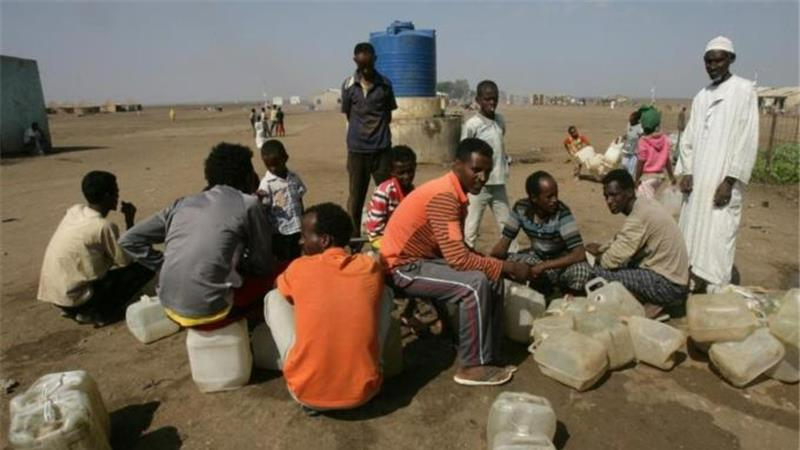
The UNHCR estimates that there are currently about 500,000 Eritrean refugees in eastern Sudan, but the actual number is likely much higher. A large number of refugees arrived over a long period, beginning with the war of independence in the 1960s. Over time, they escaped their country due to war and internal conflicts and are unable to return because of ongoing political unrest.
In recent years, an additional influx of refugees, particularly young people, arrived in neighboring countries such as Sudan, Ethiopia, and Yemen due to forced military service, the spillover of the war in Tigray, and various forms of violence. These refugees have been and are in desperate need of life-saving humanitarian aid, including food, medicine, and clean water. Additionally, there is a need for education and support for orphans
Refugee Camps with Acute Lack of Medical Services

Many Eritrean refugee camps in Eastern Sudan—such as Wad Sharifai and Kilo 26 in the state of Kassala, and Shagarab-I, II and III in the state of Gadarif—face existential problems including clean drinking water, lack of medical care, and food shortages.
In the case of medical care, there is an acute shortage of medical supplies and services. There are no adequate medical services that can meet the extreme healthcare necessity for the refugee camps. While some private health providers exist, they require considerable financial ability. The Sudanese public health system is not equipped to serve patients in the refugee camps; even if it is reached for help, it does not have the medical resources to provide free medications or perform surgeries. Therefore, the Eritrean refugees in Eastern Sudan are under a continuous medical emergency.
We at Social Impact and Development Foundation are dedicated to helping and supporting these refugees. Despite our limited resources, we have provided considerable support in the past few years, and we are appealing to the world to help us help them. We are dedicated volunteers, part of the regional society, and we deeply care about these refugees. As volunteers, we have negligible management costs for our services and can deliver aid quickly. Please support the Eritrean refugees.
Kassala State Health Situation Report
Kassala State is located in the Eastern part of the Country. The state shares an international border with Eritrea to the East, the Red Sea State from the north, Khartoum State and the River Nile State in the west and by Al-Gedaref State to the south western. The State’s area is 42,282 kilometers square with total population of 2,662,220 persons, it is composed of eleven localities, nine of these localities are primarily rural in composition while the two localities of Kassala Town and New Halfa are urban centers. The State is characterize by Long term poverty, under development, high malnutrition rate, cyclic diseases outbreaks (AWD, DF, Measles, chik, etc), high prevalence rate of endemic diseases (Malaria, TB, schistosomiasis), Prone to natural disasters like floods (Algash river) and drought, Presence of refugees camps (83,071 refugees), long and open international border with Eretria and Ethiopia.

Kassala State Health Indicators
| Maternal mortality ratio per 100,000 live births | 245 |
| Infant mortality rate (per 1,000 live births) | 62.1 |
| Under-five mortality rate (per 1,000 live births) | 80.5 |
| % of Children aged <5 years stunted | 48.8% |
| % Children aged <5 years wasted | 18.5% |
| Number of midwives recruited in permanent job | 961 |
| Measles vaccine immunization coverage (%) | 92.1% |
| Penta3 vaccine immunization coverage (%) | 94.7% |
| % of women receiving TT2 | 55.0% |
Health Situation
1.Epidemic Diseases
The State is keep monitoring trends of epidemic diseases through 158 sentinel reporting sites distributed in twelve localities according to the population density, epidemiological map of endemic diseases and history of epidemics. The completeness of the reports from sentinel reporting sites is 90%
1.2 Malaria: Malaria remains the main cause of morbidity during first have of 2022; during this year the State has reported 68,532 malaria cases with State incidence 257 cases per 10,000 population compared to 691 case per 10,000 population, reported during last year, highest number of cases as well highest Incidence rate are reported from Rural Algirba locality.
1.3 Dysentery: Dysentery is the second cause of morbidity in Kassala State after malaria during first have of 2022, the State has reported 9,633 cases during this year, with State incidence rate 36 cases per 10,000 population, highest incidence is 126/10,000 Pop reported from Nhre Atbra locality
1.4 Typhoid fever: During first have of 2022 the State reported 7,5011 Typhoid fever cases, mainly from Rural Nhre Atbra and New Halfa localities which reported 114 and 58 cases per 10,000 population respectively compared to State incidence rate 28 cases per 10,000 population.
1.5 Other endemic diseases: Schistosomiasis is endemic at Girba, New Halfa and Nhre Atbra localities, during this year the three localities reported 4080 cases, compared to 5,321 cases reported during 2020.
Epidemic Diseases
2.1 Coivd-19 Epidemic:
Covid-19 outbreak continue during 2022 and the State has reported 715 cases associated with 132 deaths since the beginning of the outbreak, CFR is 18%.
Majority of the cases (60%) are reported from Kassala locality, followed by New Halfa locality. 57% of the cases are above 60 years of age and 62% are male.
2.2 Dengue Fever Outbreak:
DF outbreak started in 5th August 2021 when one case from Kassala locality Al Murbaat Area, then no suspected cases reported till 15 August, when second suspected case reported from Banat area in Kassala locality. Last case was reported in Feb 2022, the accumulative reported cases are 915 and zero related deaths, the cases are reported from Kassala, West Kassala and rural Kassala localities, attack rate. 85% of reported cases are from Kassala localities and with the localities there are clustering of cases in Alhalanga, Almurabaat and Hai Al-Arab arears. 89 Samples are collected and sent to NPHL at Khartoum for further investigation, 25 samples shown positive result for DF, 61 samples were negative and 3 samples are in adequate.
Female cases represent 48% of total cases while Male cases counted 52%. 10 to 30 years of age are the most affected age group (42%).